
New Data in Bitcoin’s Quantum Debate: Binance-Coinbase Gap Stands Out

Glassnode reported that the amount of Bitcoin with public keys visible on the blockchain has exceeded 6 million, accounting for 83% of Binance’s holdings and 10% of Coinbase’s.
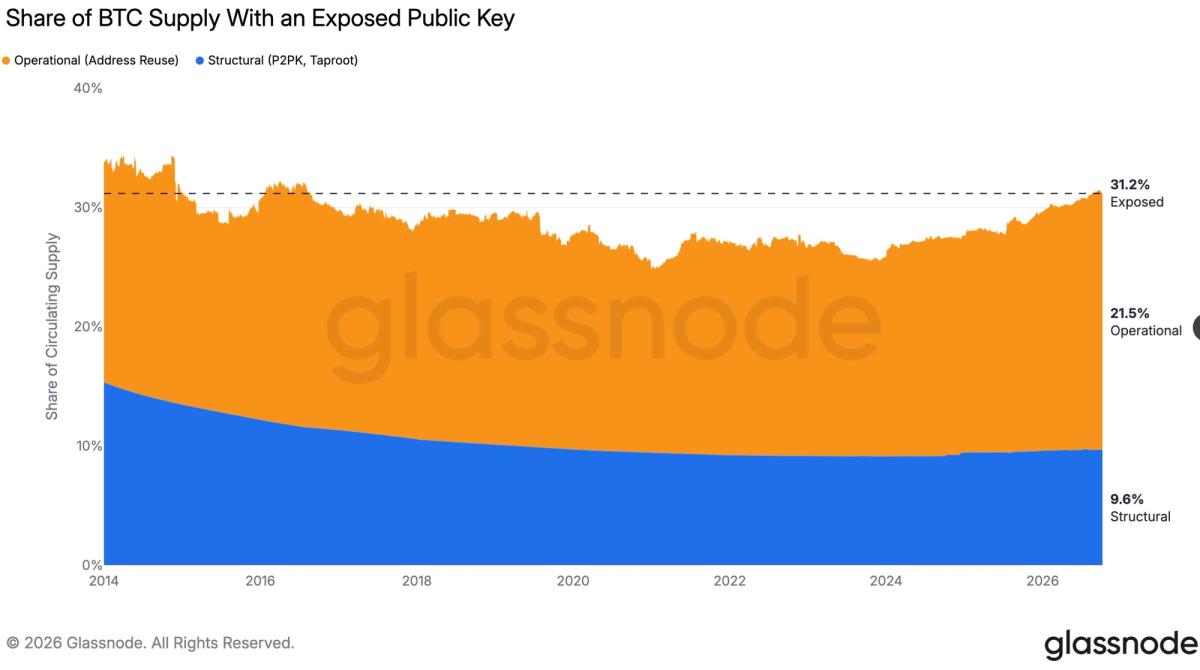
As debate continues over how artificial intelligence and quantum computers could affect the security of Bitcoin, Glassnode’s new measurement shows which holdings are concentrated in areas that could face potential risk. Coins with public keys visible on-chain account for about 31% of the circulating Bitcoin supply.
According to Glassnode co-founder Rafael Schultze-Kraft, that amount has increased by 222,000 BTC since the report in May. During the period in which this increase—calculated in the article at approximately $18.2 billion—occurred, only 64,000 BTC was added to the total Bitcoin supply.
Why are the figures for Binance and Coinbase drawing attention?
Exchanges accounted for 123,000 BTC of the increase since May. The total Bitcoin holdings of exchanges with visible public keys reached 1.79 million BTC.
However, the share of these coins in each institution’s own Bitcoin holdings varies considerably:
- Binance: 83%
- Coinbase: 10%
- Fidelity: 2%
- Grayscale: 49%
- Revolut: 99%
- Robinhood: 100%
These figures do not represent the likelihood of the institutions being hacked; they show the portion of the Bitcoin holdings included in the measurement whose public keys are visible. No such visibility was identified using the same method for the Bitcoin holdings of the U.S., U.K., and El Salvador governments.
Why does a visible public key matter?
Public keys can be visible on-chain because of address reuse or the structure of certain transaction outputs, such as older P2PK and Taproot outputs. In Glassnode’s chart, the portion attributable to address reuse represents 21.5% of the total circulating supply, while structural visibility accounts for 9.6%.
At the center of the debate is the possibility that a sufficiently powerful quantum computer or a potential mathematical breakthrough could derive a private key from a public key. Because a private key grants the authority to spend coins, such a development could make holdings with visible keys a target. The current measurement does not indicate that any encryption has been broken or that any funds have been lost.
Justin Drake, an Ethereum researcher, had called on the industry to prepare, arguing that in a worst-case scenario, AI could find a shortcut to bypass the cryptographic security of wallets “in months, not years.” Rather than providing a timeline for this scenario, Glassnode’s data shows the size of the Bitcoin holdings whose public keys are already visible and how they are distributed among institutions.