
Arc’s First Day, Launched for Institutional Payments, Shaped by Memecoins

Circle’s Arc blockchain, developed for institutional use, saw the majority of its 7.83 million first-day transactions driven by memecoin activity.
Launched by Circle on Wednesday, Arc was introduced as a payment and stablecoin network supported by institutions such as BlackRock, Visa, Mastercard, and the DTCC. However, first-day data reported by CoinDesk indicated that network congestion stemmed from speculative token transactions rather than institutional payments.
Arc processed 7.83 million transactions in its first 24 hours. In contrast, the lifetime total of USDC (USDC) transfers on the network remained at approximately 624,000. On the same day, nearly 400,000 new accounts were opened, and over 73,000 smart contracts were created. Average transaction fees rose fourfold to 3 cents.
Arc’s first-day volume driven by memecoin transactions
While memecoin transactions filled a significant portion of the blocks, several tokens on Arc retreated sharply from their launch peaks. TOLLY dropped 56%, LONG fell 77%, and COOL plunged 75%. This performance led some investors to criticize the network’s first-day activity.
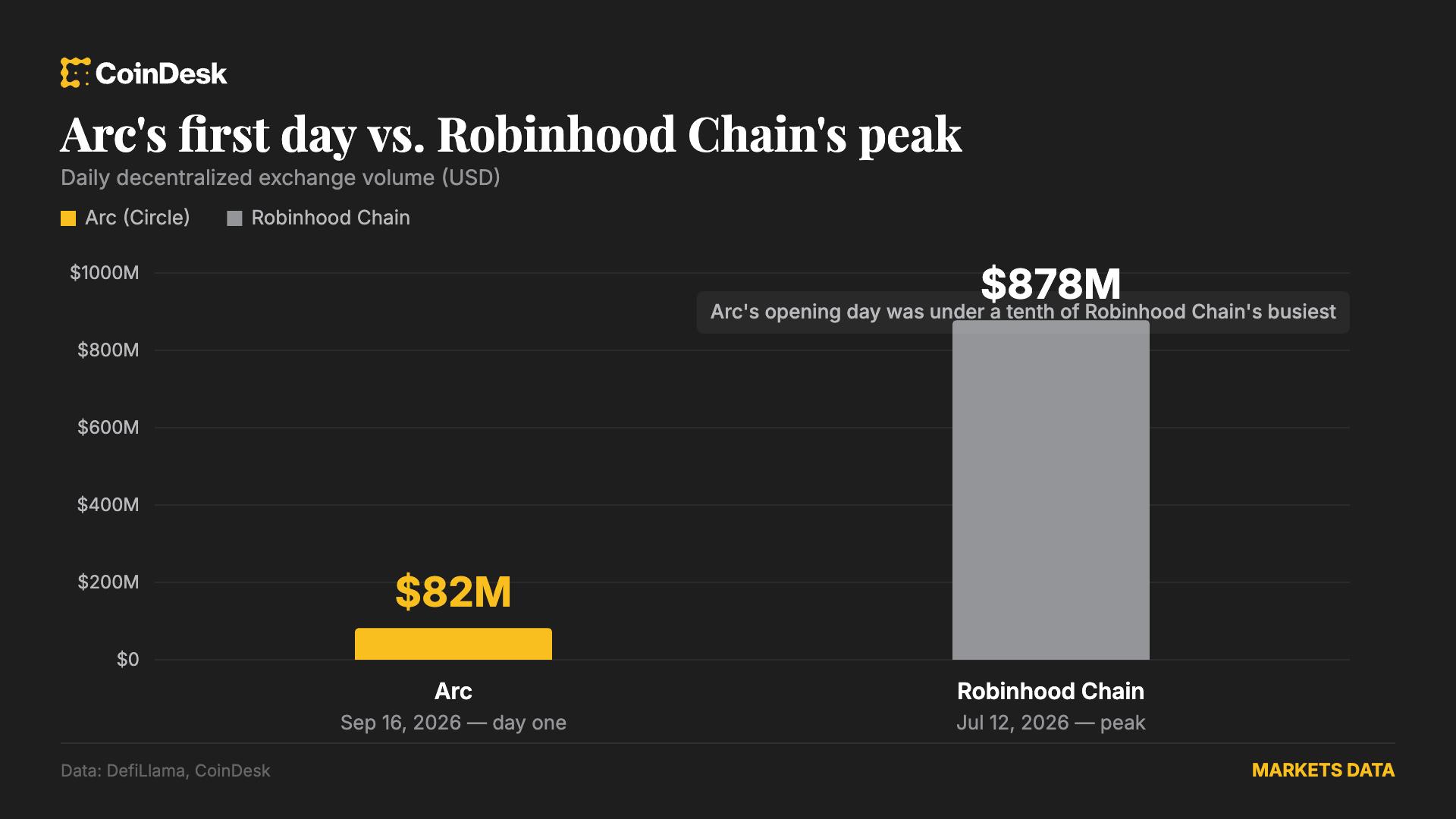
Decentralized exchange volume on Arc totaled approximately $82 million on its first day. According to a comparison shared by CoinDesk, this figure was less than one-tenth of the $878 million reached by Robinhood Chain on its peak day on July 12. While Arc’s largest token, ARGUS, reached a market capitalization of $16 million, Circle’s own products, cirBTC and EURC, ranked second and third.
Circle’s promotional approach also fueled controversy. Arc product manager Rachel Mayer shared an AI-generated image promoting the DUKE memecoin, reportedly Allaire’s dog. The post, which received nearly 1 million views, drew backlash as it suggested Circle was endorsing tokens on its own network.
From a technical standpoint, Arc functioned smoothly. The chain processed transactions with half-second blocks without congestion; decentralized finance platforms like Aave and Morpho were also present on the network from day one. Nevertheless, the first day’s economic activity was shaped more by memecoin speculation than by Circle’s goal of institutional payments.