
A Year After Bitcoin’s Peak, What’s Curbing Steep Declines?
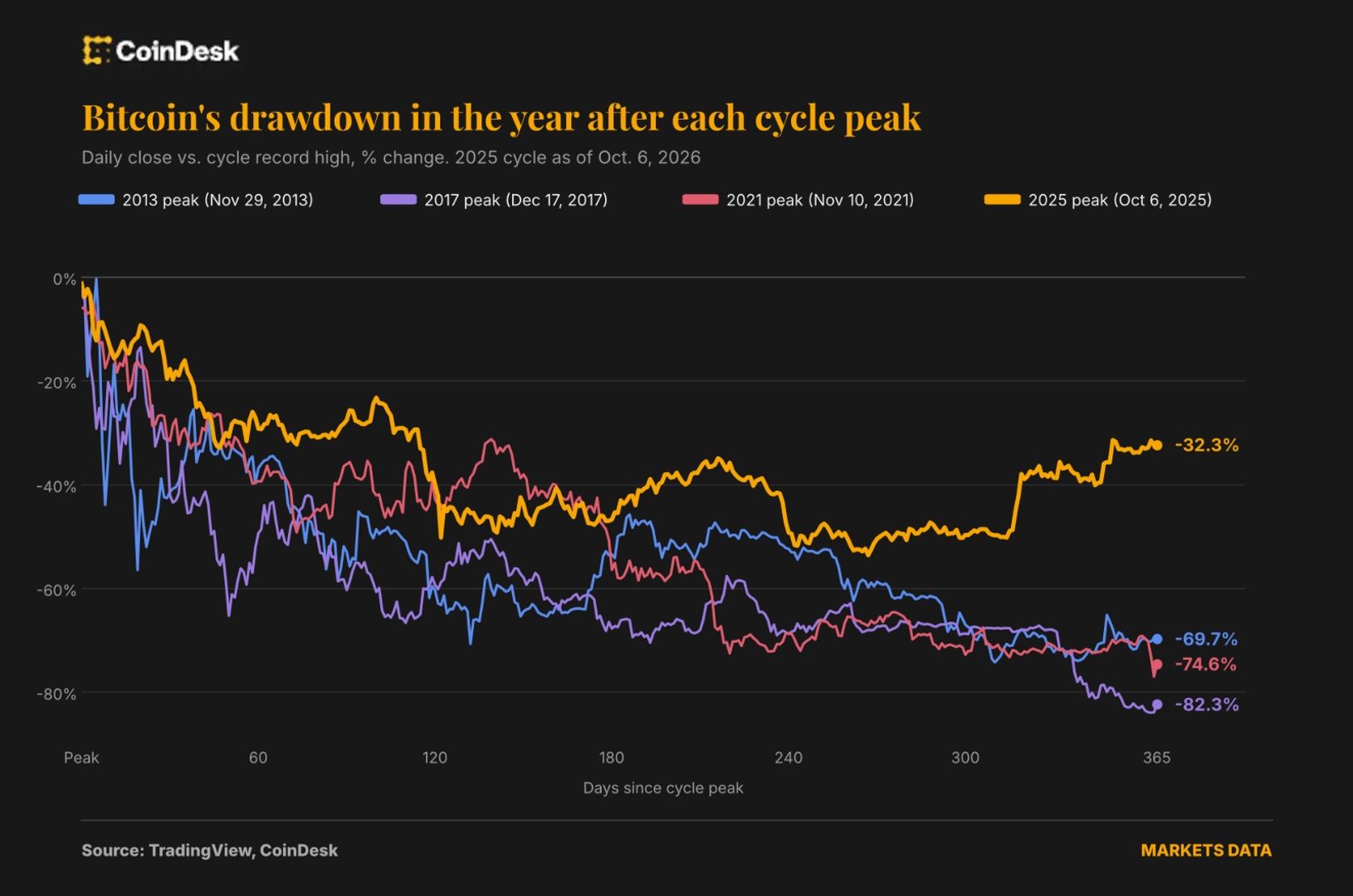
As Bitcoin remains about 32 percent below its record on the first anniversary of its peak, its more limited losses compared with previous cycles have renewed discussion of how institutional investors are changing the market.
Bitcoin set a record by climbing above $126,000 on October 6, 2025. In CoinDesk’s comparison a year later, the price stands at $85,453, representing a loss of about 32 percent from its peak.
At the same point in the previous three cycles, the picture was much worse. One year after its 2013 peak, Bitcoin had lost 69.7 percent; after its 2017 peak, 82.3 percent; and after its 2021 peak, 74.6 percent.
A shallower decline and a faster recovery
The difference is not limited to the price on the first anniversary. The lowest level seen so far in this cycle came on June 30, just below $59,000. At that point, the loss from the peak exceeded 53 percent, while declines from peak to trough in previous bear markets had reached 77-85 percent.
The low so far came about nine months after the record, and the price recovered quickly afterward. Tim Sun, a senior researcher at HashKey Group, counts the shorter duration of the decline and the reduced time spent at the bottom among this cycle’s notable differences.
ETF investors are behaving differently during the decline
According to Sun, retail investors and leverage were more influential in previous rallies, while buyers from outside the market, such as ETFs, asset managers and companies, gained prominence during 2023-2025. This time, the downturn was driven more by macroeconomic conditions and changes in portfolio preferences than by the collapse of major crypto firms.
Griffin Ardern of Primal Fund says ETF investors may buy again when prices fall to maintain their target portfolio allocations. According to Ardern, the fact that leveraged positions had largely been liquidated near the peak also limited the severity of cascading sell-offs.
A significant portion of those liquidations occurred on October 10, 2025, during a wave of selling that closed more than $19 billion in positions across crypto derivatives markets.
A calmer market is also affecting rallies
Sun says Bitcoin’s annualized volatility has fallen to about 40 percent, while its long-term levels have exceeded 80 percent. According to Jeff Anderson of STS Digital, this change could lead to more measured rallies along with shallower declines.
Still, Sun believes that strong ETF inflows over a short period, improving liquidity conditions, or a wave of short covering could trigger sharp rallies.
Ardern’s warning centers on the 30-year U.S. Treasury yield. He says that if the yield, which recently rose to 5.7 percent, continues to climb, it could create fresh selling pressure on Bitcoin. For that reason, there is no certainty that the decline, which has been shallower so far, will remain so.